
By Shelbie Hileman, DNP, APRN-BC, FNP-C for Tri County Heart Institute
Advanced cardiac rhythm evaluation and comprehensive treatment are available right here. Contact Tri County Heart Institute today.
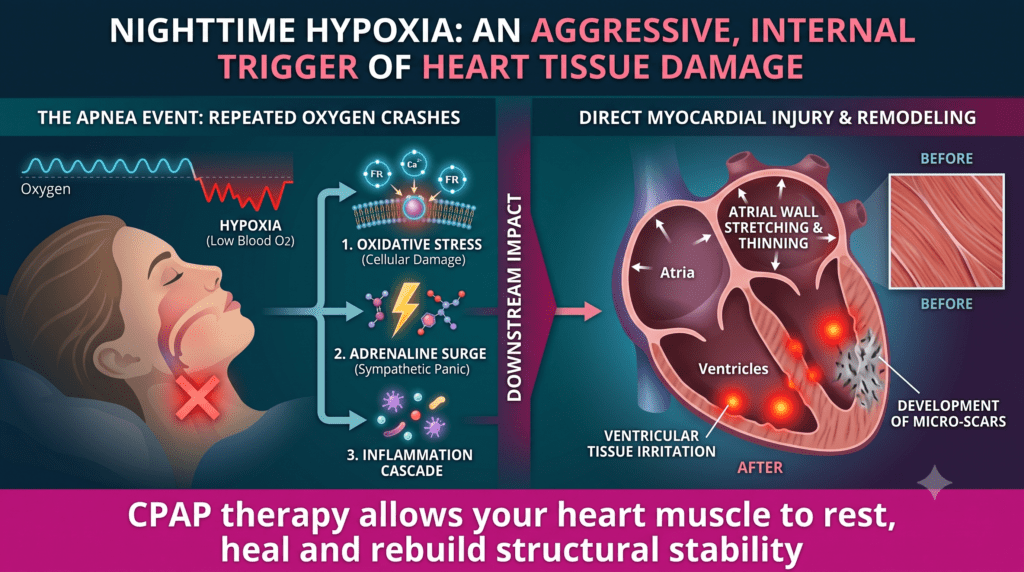
The human heart relies on a beautifully calibrated, highly sensitive electrical grid to beat steadily and effectively. For this delicate system to function properly, it requires a continuous, uncompromised supply of oxygen. When obstructive sleep apnea repeatedly chokes off that oxygen supply throughout the night, it throws the heart’s electrical system into absolute chaos, serving as a massive, hidden trigger for debilitating arrhythmias like Atrial Fibrillation (AFib) and Premature Ventricular Contractions (PVCs).
To understand why this happens, imagine what occurs mechanically during an apnea episode. As a woman sleeps, her airway closes, but her chest muscles and diaphragm continue to pull violently in an attempt to draw air into the lungs. This physical straining creates intense negative pressure within the chest cavity. This negative pressure stretches the thin walls of the heart’s upper chambers (the atria) like a balloon. Over time, this chronic stretching damages the delicate muscle tissue, creating microscopic scars. These scarred areas disrupt the smooth flow of electricity, generating chaotic, rapid signals that cause the upper chambers to quiver uncontrollably instead of pumping blood – a condition known as Atrial Fibrillation. If you previously read our April post, “Modern Solutions for AFib: Beyond Medication”, you know how essential it is to correct these electrical errors before they lead to long-term complications like stroke.
Furthermore, the profound drop in oxygen (hypoxia) combined with the accompanying massive surge of adrenaline directly irritates the heart’s lower chambers (the ventricles). This localized tissue irritation sparks premature, extra beats known as PVCs. A woman might experience this as a distinct, unsettling sensation of her heart “skipping a beat” or forcefully thumping in her chest when she tries to rest. As highlighted in our landmark February guide, “Common Triggers for Heart Palpitations”, external stress and stimulants can provoke palpitations, but chronic nighttime hypoxia is an aggressive, internal trigger that directly damages heart tissue.
In some advanced cases, the severe strain sleep apnea places on the autonomic nervous system can cause the heart’s natural pacemaker to slow down to dangerously low levels during sleep (severe bradycardia), alternating with rapid bursts of AFib during the daytime. When the heart’s underlying wiring becomes permanently damaged by this cycle, a medical device becomes necessary to maintain a safe, steady rhythm, as we outlined in our July Blog #3 regarding the evolution of modern pacemakers. At Tri County Heart Institute, we work diligently to identify patients in The Villages and Leesburg whose arrhythmias are driven by undiagnosed sleep apnea, ensuring we treat the root cause of the rhythm disturbance rather than simply managing the symptoms.
How Mechanical Heart Stretching Changes Electrical Conductance
The connection between sleep apnea and Atrial Fibrillation is deeply rooted in physical anatomy. Every time a woman stops breathing, the severe vacuum effect created in her chest pulls extra blood back into the right side of the heart, putting immense structural strain on the thin-walled upper chambers. This nightly stretching forces the cells of the atria to pull apart slightly, disrupting their tight electrical connections.
As this stretching occurs hundreds of times a week, the heart muscle responds by laying down fibrous scar tissue to reinforce the walls. Unfortunately, scar tissue cannot conduct electricity. The heart’s natural electrical impulses hit these tiny patches of scar tissue and are forced to detour, spinning off into chaotic micro-circuits. This is the direct mechanism behind an AFib episode. If we only treat the AFib with medication or an ablation without resolving the sleep apnea, the continuous nighttime stretching will keep creating new areas of scar tissue, causing the arrhythmia to return.
The Autonomic Rollercoaster: Brady-Tachy Syndrome
Sleep apnea subjects the body to a severe autonomic rollercoaster. During the actual pause in breathing, the body enters a state of conservation, dropping the heart rate significantly (bradycardia). Heart rates can drop into the 30s or 40s during a severe apnea episode.
However, the moment the brain registers the oxygen crisis and forces a sudden awakening, the sympathetic nervous system fires instantly, floods the system with adrenaline, and causes the heart rate to skyrocket into a rapid rhythm (tachycardia). This constant shifting between extreme slow and extreme fast strains the heart’s electrical pathways. Over time, the sinus node – the heart’s natural master clock – becomes worn out, leading to sinus node dysfunction. This is why managing sleep disorders is an essential component of comprehensive heart rhythm therapy.
Uncovering the Root Cause for Lasting Stability
Managing a complex rhythm issue without investigating a patient’s sleep quality is like trying to heal a sunburn while standing directly under the blazing Florida sun. Lasting stability requires a comprehensive, holistic look at how your heart behaves over a full 24-hour cycle. We combine advanced, long-term cardiac rhythm monitoring with targeted sleep evaluations to uncover hidden issues. If we discover that your heart palpitations or irregular beats spike during the overnight hours, an automated home sleep study may be the key to unlocking your recovery.
Fortunately, modern sleep diagnostics have evolved to be incredibly simple and non-invasive, allowing you to comfortably complete an evaluation in your own bed. If a sleep disorder is identified, implementing an effective therapy – such as Continuous Positive Airway Pressure (CPAP) or a specialized oral appliance – can dramatically change your cardiovascular trajectory. By keeping the airway gently open, these therapies prevent blood oxygen drops, eliminate the panic-driven surges of nighttime adrenaline, and allow your heart muscle to rest, heal, and rebuild structural stability. This structured path toward wellness mirrors the proactive steps outlined in our June blog regarding the journey to lifestyle stability. By partnering with our dedicated clinical team, you can address both your heart and your sleep, successfully reclaiming your energy, your health, and your active life in Central Florida.
Educational information only. This article is not medical advice and is not a substitute for a personal evaluation by a licensed clinician. It does not diagnose any condition or recommend any treatment. Device details vary by manufacturer and model – your cardiologist will review the specifics that apply to you. If you are having chest pain, severe shortness of breath, fainting, or other emergency symptoms, call 911.