
By Shelbie Hileman, Nurse Practitioner — Tri County Heart Institute, The Villages, FL
Take control of your heart health with expert diagnostic clarity. Contact our Leesburg or Villages office today: https://www.tc-heart.com/contact-us/
Imagine experiencing sudden, crushing chest pain, severe shortness of breath, and a cold sweat immediately after receiving tragic news or enduring an terrifying life event. Naturally, your immediate assumption—and the assumption of emergency medical personnel—will be that you are suffering a classic, life-threatening heart attack (myocardial infarction). You are rushed to the hospital, an EKG is performed, and initial blood tests reveal elevated cardiac enzymes indicating heart muscle distress. Yet, when doctors perform an angiogram to locate the blocked artery, they find something astonishing: your coronary arteries are completely clear and open, with no sign of a ruptured plaque or major clot.
This perplexing scenario is the classic diagnostic narrative of Takotsubo Cardiomyopathy (Broken Heart Syndrome). For women in The Villages, Leesburg, and Lake County, sitting with this diagnostic mystery can be incredibly confusing and frightening. How can a medical event present with every classic hallmark of a severe heart attack, yet leave the heart’s major arteries entirely unblocked?
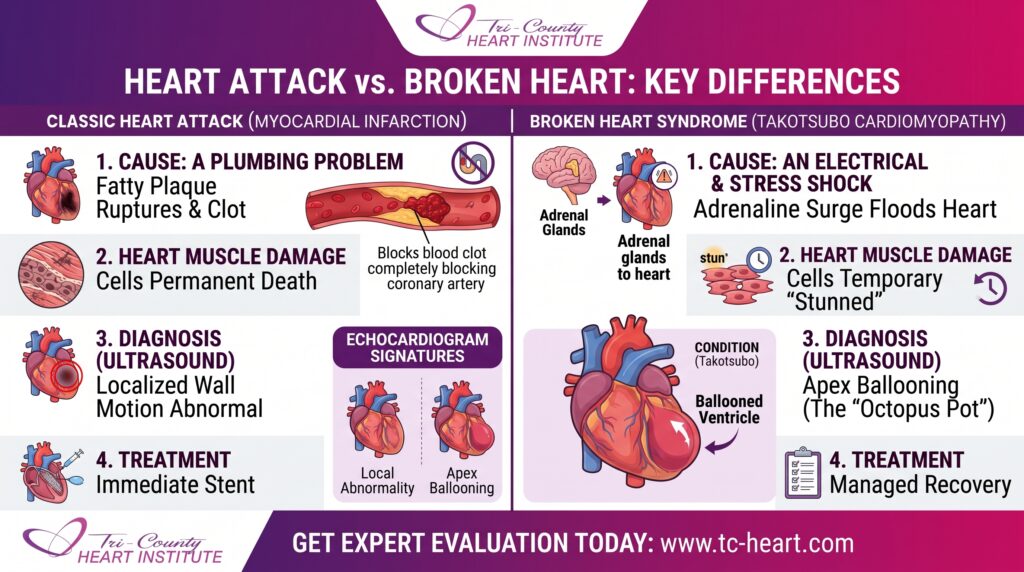
To understand the key differences, we must contrast the underlying mechanics of both conditions. A standard heart attack is primarily a vascular plumbing problem. It occurs when a fatty plaque inside one of the main coronary arteries ruptures, forming a blood clot that completely blocks oxygen-rich blood from reaching a segment of the heart muscle. Without immediate intervention to open the artery (such as a stent or balloon angioplasty), the oxygen-starved muscle tissue begins to permanently die, leaving behind permanent scar tissue.
In contrast, Broken Heart Syndrome is fundamentally an acute cellular and microvascular electrical problem. It is not caused by a physical blockage in a large artery. Instead, as the massive rush of stress hormones floods the heart, it causes widespread microvascular spasms—temporary contractions in the microscopic blood vessels that branch off the main arteries. Simultaneously, these excess stress hormones overwhelm the heart cells, causing temporary metabolic paralysis (stunning) without permanently killing the tissue. This difference explains why, unlike a traditional heart attack, the structural damage caused by Takotsubo Cardiomyopathy is frequently reversible if caught and managed properly.
Uncovering the precise difference between these two conditions requires a systematic, detail-oriented diagnostic approach. As we highlighted in September Blog 1: What to Expect Before a Heart Diagnosis, a proper evaluation relies heavily on advanced imaging. One of the most vital non-invasive tools we utilize at Tri County Heart Institute is the echocardiogram (a specialized ultrasound of the heart). An echocardiogram allows us to view the physical motion of your heart chambers in real time.
When a patient has suffered a traditional heart attack, the echocardiogram shows a localized area of wall motion abnormality corresponding strictly to the specific territory of the blocked artery. But with Takotsubo Cardiomyopathy, the echocardiogram reveals a very distinct, classic signature: the apex (tip) of the left ventricle balloons outward and remains completely still, while the base of the heart contracts normally or hyperactively. This unique ballooning shape—the classic “octopus pot” visual—instantly alerts the clinician that they are dealing with stress-induced cardiomyopathy rather than permanent arterial death.
Furthermore, monitoring the heart’s electrical system provides vital diagnostic clues. A patient with Broken Heart Syndrome will often display temporary EKG abnormalities that mimic an acute heart attack, including ST-segment elevations and T-wave inversions. Additionally, because the stunned heart muscle is under intense mechanical strain, it releases elevated levels of troponin into the bloodstream—the same protein marker released during a heart attack, though often in lower amounts relative to the severe degree of wall motion abnormality seen on the ultrasound.
Connecting these diagnostic pieces requires a clinical team that understands the nuanced nuances of female heart presentation. As we detailed in our April post regarding AFib solutions, getting an accurate diagnosis is the essential foundation for preventing long-term cardiovascular complications. By distinguishing between an arterial blockage and a stress-induced stun, we can tailor a recovery plan that protects your heart muscle while it heals.
Call us at 352-504-3500 to schedule, or visit www.tc-heart.com
Tri County Heart Institute • 1501 N US HWY 441, Bldg 1100, Suite 1106, The Villages, FL 32159 • Phone 352-504-3500 • Fax 352-504-3388 • info@tc-heart.com
Educational information only. This article is not medical advice and is not a substitute for a personal evaluation by a licensed clinician. It does not diagnose any condition or recommend any treatment. Device details vary by manufacturer and model – your cardiologist will review the specifics that apply to you. If you are having chest pain, severe shortness of breath, fainting, or other emergency symptoms, call 911.