
By Shelbie Hileman, Nurse Practitioner — Tri County Heart Institute, The Villages, FL
Don’t ignore chest pain or stress-induced symptoms. Schedule a comprehensive cardiovascular evaluation at Tri County Heart Institute today: https://www.tc-heart.com/contact-us/
For centuries, phrases like “a broken heart” were reserved for poetry, music, and dramatic literature. We used them metaphorically to describe the intense emotional ache that accompanies profound grief, the sudden loss of a loved one, or a devastating life shock. However, modern cardiovascular medicine has revealed a startling biological reality: an intense emotional event can quite literally break your heart rhythm and temporary muscle function. Clinically known as Takotsubo Cardiomyopathy—and colloquially called Broken Heart Syndrome—this condition represents a profound, direct intersection between human emotion and physical cardiac anatomy.
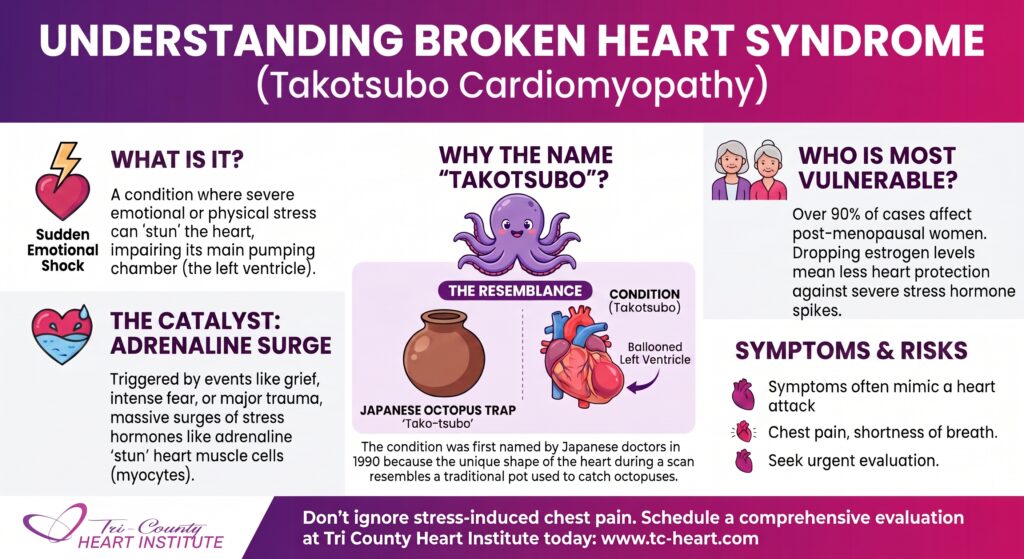
At Tri County Heart Institute, serving patients across The Villages, Leesburg, and Lake County, our guiding principle remains steadfast: women are not just smaller men. This perspective is nowhere more critical than in diagnosing and treating Takotsubo Cardiomyopathy. Clinical data reveals an overwhelming demographic pattern: over 90% of documented Broken Heart Syndrome cases occur in post-menopausal women. Despite this massive skew, many women who experience sudden chest tightness or shortness of breath following a stressful life event are dismissed—or dismiss themselves—assuming they are merely suffering from a severe panic attack or generalized emotional distress.
To understand why Takotsubo Cardiomyopathy occurs, it is essential to look at what happens inside the body during an acute psychological crisis. When an individual experiences a sudden, overwhelming shock—such as the unexpected passing of a spouse, a catastrophic financial loss, a terrifying accident, or even an intense physical trauma like major surgery—the brain’s amygdala signals an emergency. In response, the adrenal glands instantly flood the cardiovascular system with a massive, unprecedented surge of stress hormones, primarily adrenaline and noradrenaline.
In a healthy body under everyday stress, small amounts of adrenaline help increase blood flow and alertness. But during a catastrophic emotional event, this massive hormonal tidal wave effectively “stuns” the heart muscle cells (myocytes). This adrenaline surge causes the small blood vessels supplying the heart to constrict rapidly while simultaneously overwhelming the heart’s cellular receptors. The result is a sudden, dramatic weakness in the main pumping chamber of the heart (the left ventricle).
The term Takotsubo originates from Japanese cardiologists who first identified the condition in 1990. They noticed that during diagnostic imaging, the stunned left ventricle of the patient’s heart ballooned outward at the apex, taking on a shape that strikingly resembled a traditional Japanese octopus trap (tako-tsubo). While the bottom section of the heart muscle freezes and fails to contract, the upper neck of the ventricle squeezes frantically. This sudden change in heart structure drastically impairs the heart’s ability to pump blood effectively to the rest of the body, producing symptoms that are virtually indistinguishable from a classic, severe heart attack.
As we introduced in What to Expect Before a Heart Diagnosis, bringing your symptoms to a clinical team without delay is the single most important action you can take. Women living in Central Florida must understand that physical symptoms following an emotional shock are not “just in your head.” They are real biological reactions that require precise medical evaluation to ensure your heart muscle recovers fully and safely.
Why Post-Menopausal Women Are Most Vulnerable
The overwhelmingly high prevalence of Takotsubo Cardiomyopathy among post-menopausal women points directly to the protective role of estrogen. As we discussed extensively during our August Blog Series on Menopause and Sleep Apnea, estrogen acts as a crucial biological shield for the female cardiovascular system. It helps maintain endothelial function, keeps blood vessels flexible, and protects heart cells against oxidative stress and excessive catecholamine (adrenaline) toxicity.
When a woman transitions through menopause, her circulating estrogen levels drop sharply. Without this hormonal buffer, the microscopic blood vessels in her heart become significantly more sensitive to sudden spikes in stress hormones. When an emotional tragedy occurs, the unbuffered heart tissue absorbs the full, harsh blow of the adrenaline surge. Recognizing this unique physiological vulnerability allows our team at Tri County Heart Institute to provide targeted, compassionate care specifically tailored to mature women navigating major life changes.
Call us at 352-504-3500 to schedule, or visit www.tc-heart.com
Tri County Heart Institute • 1501 N US HWY 441, Bldg 1100, Suite 1106, The Villages, FL 32159 • Phone 352-504-3500 • Fax 352-504-3388 • info@tc-heart.com
Educational information only. This article is not medical advice and is not a substitute for a personal evaluation by a licensed clinician. It does not diagnose any condition or recommend any treatment. Device details vary by manufacturer and model – your cardiologist will review the specifics that apply to you. If you are having chest pain, severe shortness of breath, fainting, or other emergency symptoms, call 911.